
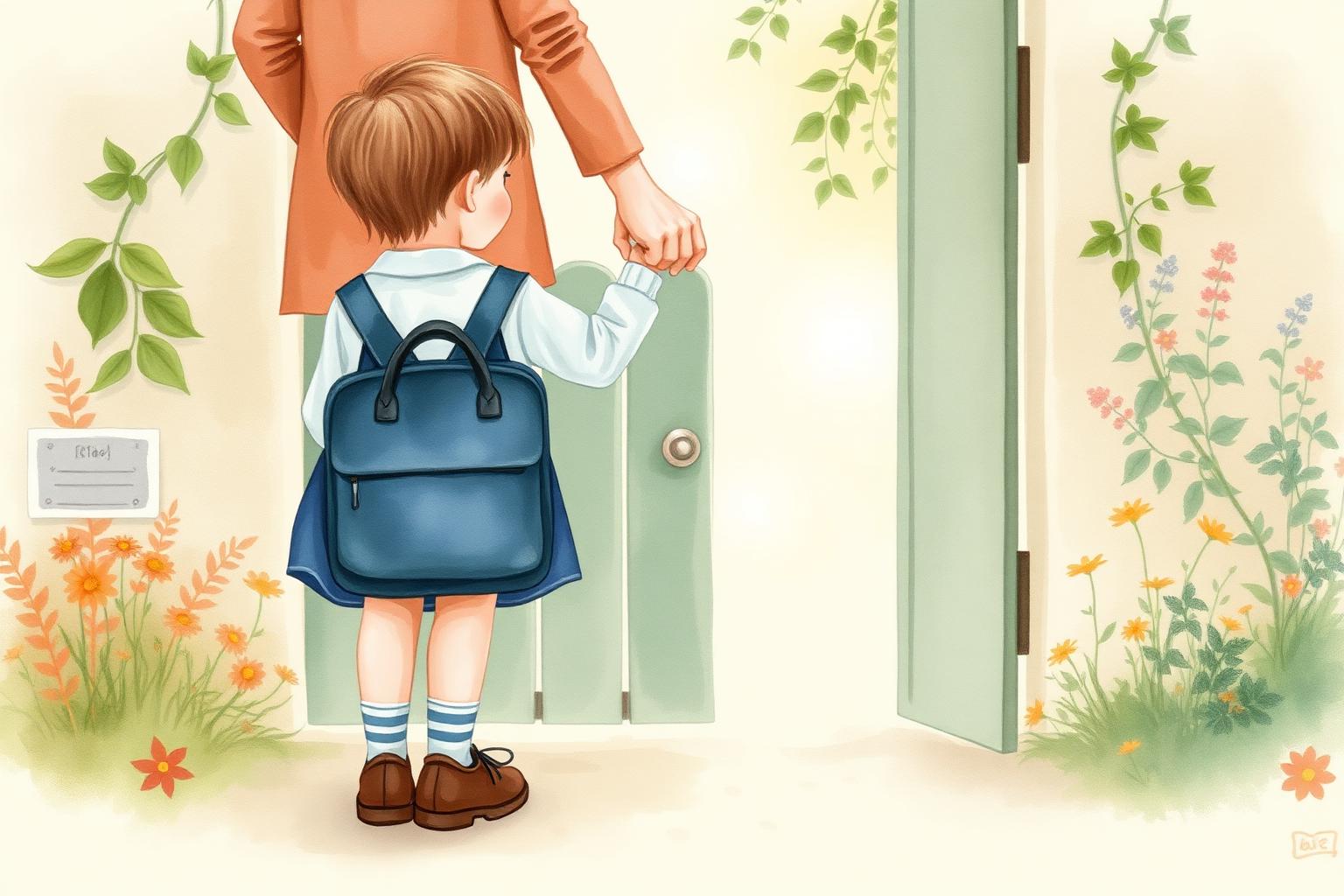
What schools actually hope for on day one
Teachers in junior infants are not expecting a child who can read. They are hoping for a child who can manage a coat, open a lunchbox, ask for the toilet, and cope with being one of thirty rather than the centre of the room.
Those are practical skills, and every one of them can be practised at home in a fortnight without a single worksheet. Let your child open their own lunchbox at the kitchen table. Let them struggle with the zip before you step in.
The rest — letters, numbers, writing their name — is the school's job. You are not behind.
Practise the shape of the day, not the school
Children settle faster when the rhythm is already familiar. Two weeks out, start shifting bedtime and waking in fifteen-minute steps rather than all at once, and eat lunch at the time they will eat it in school.
Walk or drive the route once or twice so the journey is known. If the school runs a visit morning, go — the building being ordinary matters more than anything you can describe.
Predictability is what frees a child to be curious. If the day has a known shape, their energy goes into the classroom instead of bracing for the unknown.
Infographic
The four weeks before school
A week-by-week plan for a calmer September, without flashcards.
Week 1 — self-help skills
Coats, zips, lunchboxes, toilet and hand-washing. Let them struggle first.
Week 2 — shift the rhythm
Bedtime and waking in 15-minute steps. Eat lunch at school lunchtime.
Week 3 — make it ordinary
Walk the route, see the building, answer the questions they actually ask.
Week 4 — rehearse the goodbye
One hug, one sentence, go. Same words every morning.
September — protect the evenings
Food, movement, quiet. Plain weeks. Expect a dip at week three.
Education and support for adults, not therapy. Worried about development? Talk to your GP or public health nurse.
Talk about it — but not constantly
A little and often works. Long, earnest conversations about how exciting it will be can read to a child as a signal that something worrying is coming.
Answer the questions they actually ask, in small honest pieces: who will be there, what happens first, where you will be, and when you are coming back. 'After little break and lunch' means more than a clock time.
Leave room for mixed feelings. 'Some of it will be brilliant and some of it will be tiring' is more useful, and more true, than promising it will all be lovely.
The goodbye is a skill, and it is yours
Short, warm and predictable beats long and wobbly. One hug, one sentence you use every day, and go. Slipping away while they are distracted almost always makes the next morning harder, because it teaches them to keep watch.
Tears at the door are not evidence of a mistake. They are evidence that you matter. Most children settle within minutes — ask the teacher rather than guessing.
Expect a dip two or three weeks in, when the newness wears off and the tiredness lands. It usually passes with consistency rather than change.
Protect the after-school hour
The hours after school are where the day gets digested. Most children need food, movement and quiet before they can talk, so the car-park interrogation rarely works.
Skip 'what did you do today?' for a while. 'Who did you sit beside?' or simply being nearby while they play will get you more.
Keep the evenings unusually plain for the first month. Big feelings at home after a contained day are normal — it means they held it together where they needed to.
Where the community evening fits
Our in-person evening in Gorey is built for exactly these weeks: a small, warm group of parents in the same boat, tea, coffee and treats, and guidance from Amy rather than a lecture. You leave with a plan for your child, not a leaflet.
A note on scope: Amy Byrne is an early years educator currently studying a Level 9 postgraduate in play therapy, and is not a qualified play therapist. These sessions are education and support for adults. If you are worried about your child's development, speak to your GP or public health nurse.
Frequently asked questions
- How do I prepare my child for starting school in Ireland?
- Focus on self-help skills rather than academics: managing a coat, opening a lunchbox, asking for the toilet and washing hands. Shift bedtime gradually in the fortnight before, walk the route, and rehearse a short, predictable goodbye.
- What should my child be able to do before junior infants?
- Junior infants teachers expect practical independence, not reading or writing. Dressing with some help, using the toilet, eating lunch independently, and coping with being one of a large group all matter far more.
- My child cries at drop-off — am I doing something wrong?
- No. Tears at the door usually mean your relationship matters, not that the school is wrong. Keep the goodbye short, warm and identical each day, never slip away unseen, and ask the teacher how long it took your child to settle.
- Why is my child fine at school but falling apart at home?
- Because they held it together all day where they had to. Big feelings after school are a sign of effort, not regression. Offer food, movement and quiet before conversation, and keep the first few weeks of evenings plain.
- Is there support for parents whose child is starting school?
- Yes — Roots of Wonder runs an in-person community evening in Gorey for parents, €15 per person, with tea, coffee and treats, guidance from Amy Byrne and a small group of parents in the same position.
Workshops in this post
Starting School with Confidence — a community evening for parents
In person · Gorey Enterprise Centre · 6–7pm · €15 · tea, coffee and treats included
A supportive get-together for parents whose child is starting school, with guidance from Amy and space to share what is worrying you.
Book this eveningPrivate 30-minute 1:1 session with Amy
In person · 30 minutes · €25
Bring one particular child and one particular worry, and leave with two or three things to try this week.
Book a 1:1
Keep reading
- TopicCurriculum planningWorkshops on curriculum planningExplore
- TopicEmotional regulationWorkshops on emotional regulationExplore
- CourseAistear in Practice: Planning from Children's InterestsA plain-English course on Aistear's four themes and how to plan emergent, interest-led experiences without disappearing into paperwork.Explore
- CourseBig Feelings: Calm Responses to Toddler TantrumsA short, practical course on why tantrums happen, what a child's brain can and cannot do mid-meltdown, and a repeatable way to respond that protects both the limit and the relationship.Explore
- BlogThe ECCE scheme explained: free preschool in Ireland, in plain EnglishWhat the ECCE scheme is, what age your child needs to be, how many days it covers and how to apply — plus how to tell whether a preschool is a good fit.Explore
- BlogHow to handle toddler tantrums calmly (without giving in)When tantrums start, why they happen, what to do in the middle of one, and what actually reduces them over time — for 2, 3, 4 and 5 year olds.Explore
Bring these ideas into practice
Book a workshop to explore this further with Amy.
Trusted early years resources
Every workshop is grounded in Irish early years frameworks and national guidance.
- Aistear: the Early Childhood Curriculum Framework (NCCA)
- Síolta: the National Quality Framework
- Children First national guidance (Tusla)
- First 5: Ireland's strategy for babies & young children
- Early Childhood Ireland
Workshop themes · Book a date · Counties we serve · Play & learning blog · FAQ · About Amy