
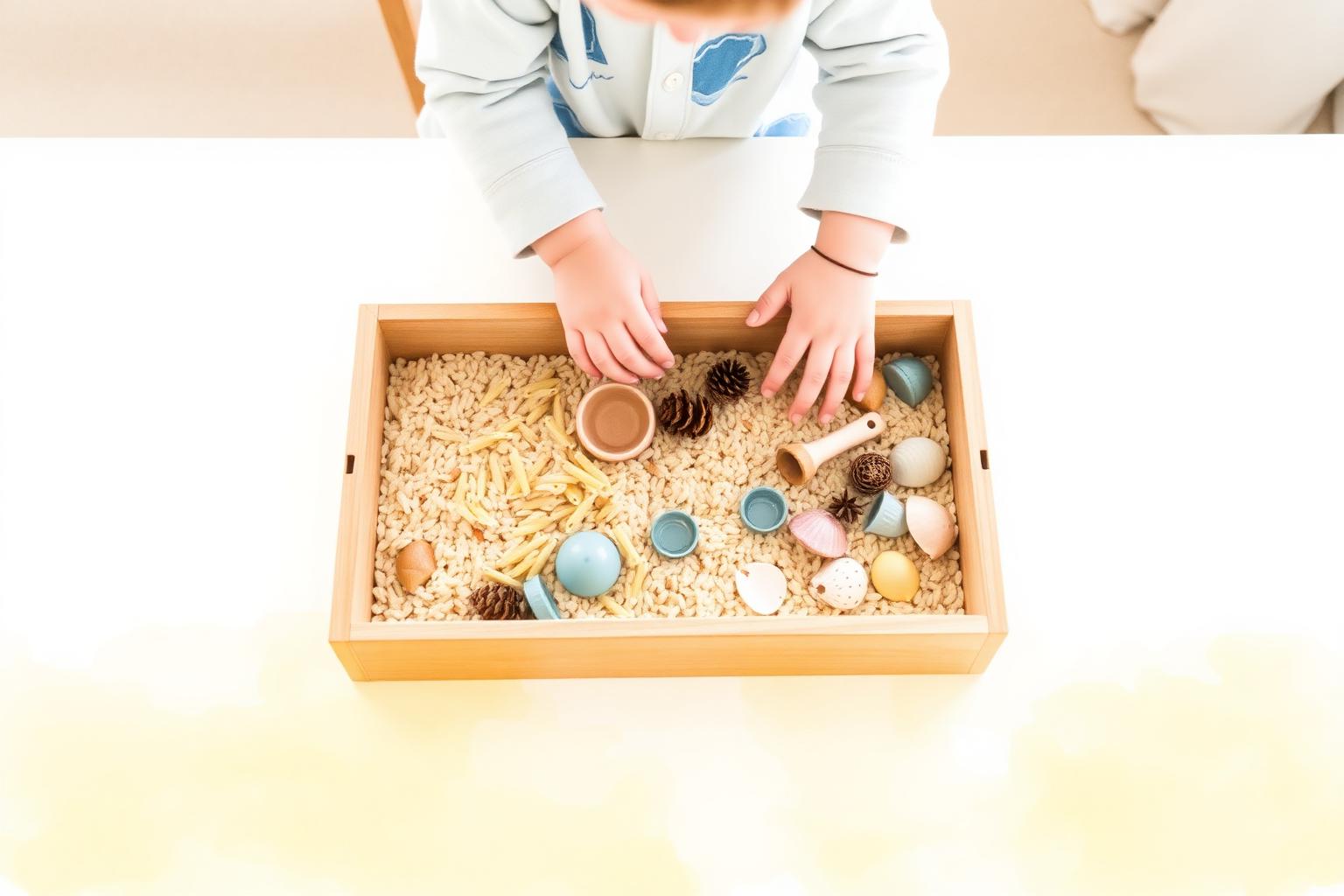
What a sensory bin actually is (and why toddlers love them)
A sensory bin is nothing more than a shallow container holding a filler — dried rice, oats, water, soil — with a few tools and objects to explore it with. That's it. No kit, no subscription box, no theme required.
For a toddler, that container is a small, contained world they are fully in charge of. Scooping, pouring, burying and digging out gives their hands repeated practice at grip, transfer and control, while the language of play — full, empty, heavy, gone, more — arrives naturally alongside it.
Sensory play for toddlers is also, quietly, regulating work. Repetitive pouring and sifting is soothing for many children, which is why a bin often calms a tetchy late afternoon better than a new toy does.
Ten sensory bin ideas from things you already have
1. Dried rice with cups, spoons and a funnel. The classic starting point — cheap, dry and easy to sweep.
2. Warm water with a squirt of washing-up liquid, plus sponges and a small brush for washing toy dishes.
3. Dried pasta shapes with tongs, an empty egg carton and a jug for sorting and transferring.
4. Soil or compost with spoons, small pots and a few seeds — a windowsill garden in a box.
5. Torn paper or shredded junk mail with bottle caps hidden inside for a hunt.
6. Porridge oats with wooden spoons, a whisk and a couple of jars for 'baking'.
7. Ice cubes in a tray of water with a slotted spoon, watching them shrink and disappear.
8. Dry pulses (for over-threes) with a colander, a sieve and a bowl for sifting.
9. Autumn finds — pinecones, conkers, leaves, smooth stones — with a basket and a magnifying glass.
10. Bubble foam: a little washing-up liquid and water whisked hard, with plastic animals to hide and rescue.
Loose parts are what make a bin last
The filler is only half of it. What keeps a toddler in a bin for twenty minutes rather than two is the loose parts — open-ended objects with no fixed use. Bottle caps, corks, wooden pegs, ribbon offcuts, cardboard tubes, jar lids, shells, old keys, fabric scraps.
Because loose parts don't decide the play, the child has to. That's where problem-solving, storytelling and stubborn little bursts of concentration come from. Rotate two or three in and out each week rather than offering everything at once — a smaller invitation is almost always a richer one.
Setting it up with less mess and less stress
Put the bin on a towel, an old sheet or a shower curtain — then tidying is one shake outdoors rather than a hoover. Choose a container with low sides so small arms can reach in comfortably, and fill it only a third full.
Agree one simple rule before you start ('the rice stays in the tray') and expect it to be broken while your toddler learns it. Sit near, resist narrating, and let them lead. Twenty minutes is a good bin; five minutes is also a good bin.
Store the filler in a lidded box or a zip bag and it will last for months. Dry fillers can be reused many times; water and food-based ones are once-off.
Safety, honestly
Sensory bins need supervision, every time. Small items are a choking risk and are not suitable for children under three or for any child who still mouths objects — for those toddlers, stick to large loose parts, water play, or edible fillers like cooked pasta and oats.
Check for sharp edges, keep water play shallow and never leave a child alone with it, and wash hands after soil or compost play. If you'd rather not use food as a filler, water, soil, leaves, torn paper and fabric all work beautifully.
Want to go further?
This is exactly the ground we cover in the workshop 'Sensory Play at Home Without the Stress' — how to set up invitations that suit your child, your space and your tolerance for mess, and what to do when a child dumps the whole tray on the floor.
If you're an early years educator, the same principles run through our open-ended materials sessions, with an eye to Aistear's themes of Exploring and Thinking and Well-being.
Bring these ideas into practice
Book a workshop to explore this further with Amy.
Trusted early years resources
Every workshop is grounded in Irish early years frameworks and national guidance.
- Aistear: the Early Childhood Curriculum Framework (NCCA)
- Síolta: the National Quality Framework
- Children First national guidance (Tusla)
- First 5: Ireland's strategy for babies & young children
- Early Childhood Ireland
Workshop themes · Book a date · Counties we serve · Play & learning blog · FAQ · About Amy