
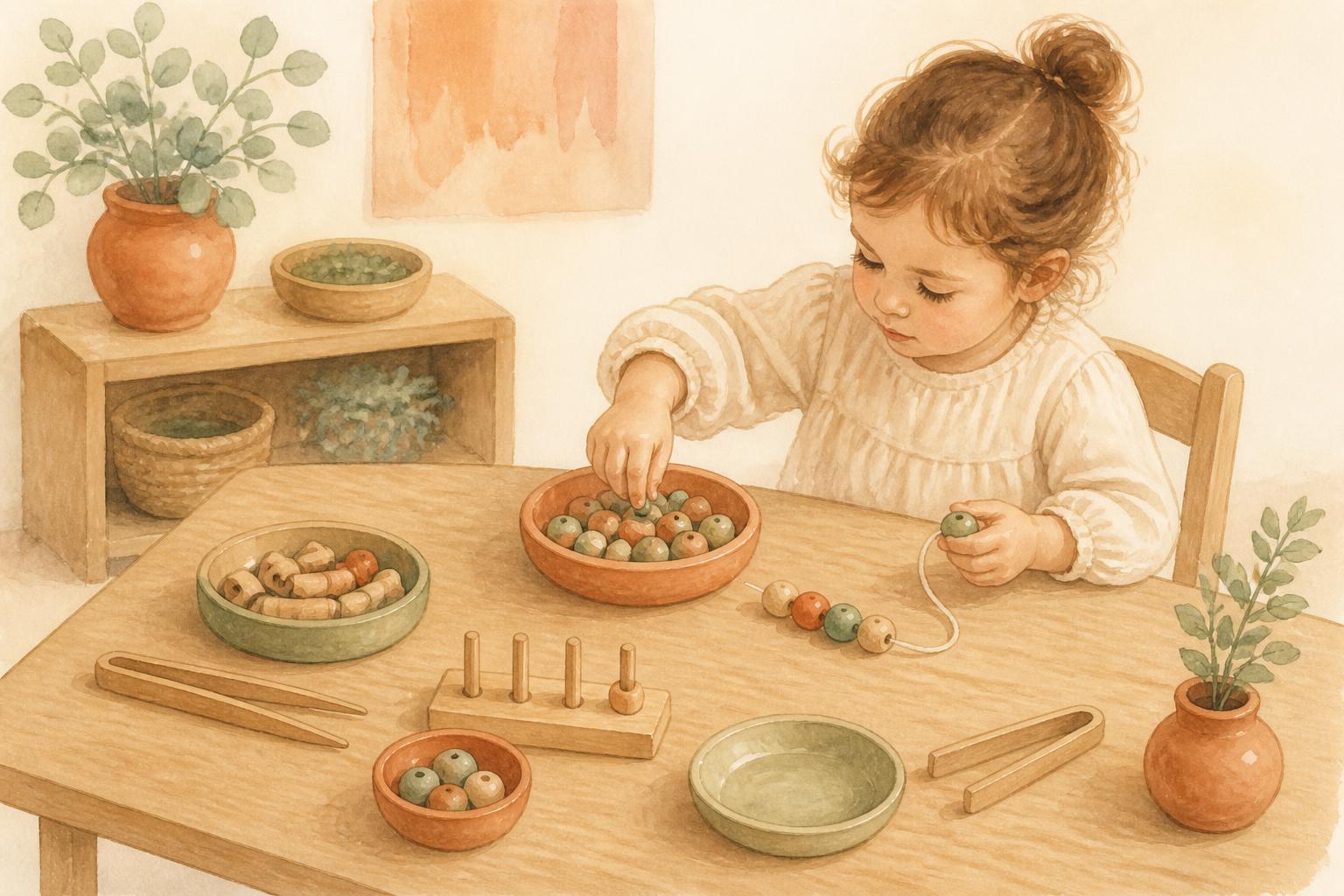
What fine motor skills really are
Fine motor skill is the control of the small muscles of the hands and fingers. It rests on bigger foundations: shoulder and core stability, then wrist control, then finger isolation and the pincer grip.
This is why crawling, climbing, hanging and pushing matter for handwriting later. A child who cannot stabilise their shoulder will struggle to control a pencil no matter how many tracing sheets they complete.
Two-handed coordination is the other half — one hand holding while the other works. Threading, pouring and opening containers all rehearse it.
Twelve activities using things you already own
1. Threading dry pasta or large beads onto a shoelace with a taped end.
2. Posting bottle caps or coins into a slot cut in a jar lid or shoebox.
3. Pegging pegs around the rim of a bowl or a piece of card.
4. Tearing paper into a bowl, then scrunching it into balls.
5. Transferring water between two jugs with a sponge or turkey baster.
6. Tongs and pom-poms — or tongs and cotton wool — moving items between two containers.
7. Playdough: rolling, pinching, poking, and hiding small objects inside for rescue.
8. Screwing and unscrewing jar lids of different sizes.
9. Stickers — peeling them off the sheet is the exercise, not where they land.
10. Painting a wall or path with water and a decorating brush.
11. Sorting buttons or bottle caps into an egg carton by colour.
12. Helping in the kitchen: stirring, kneading, snapping green beans, spreading butter.
Infographic
The fine motor ladder
Skills build from the shoulder outward — pencil grip is the last rung, not the first.
Core and shoulder
Crawling, climbing, hanging, pushing. Handwriting starts here.
Wrist control
Painting on a vertical surface, wiping, stirring, big scooping.
Whole-hand grasp
Holding jugs, scrunching paper, squeezing sponges and playdough.
Two hands together
Threading, unscrewing lids, holding the bowl while stirring.
Pincer grip
Pegs, stickers, posting caps, picking up pom-poms with tongs.
Tool use
Blunt scissors, chunky brushes, and eventually a pencil — supervised.
Small parts are a choking risk. Under-threes need larger loose parts and constant supervision.
How to set it up so it lasts more than four minutes
Offer one invitation at a time on a tray, with two or three elements only. A smaller invitation is almost always a richer one.
Sit near and stay quiet. Corrections and coaching shorten play; a calm nearby adult lengthens it.
Expect the activity to be used 'wrong'. A child who tips the pasta out and swirls it is still working their hands.
Rotate rather than accumulate. Two trays a week, swapped, beats a cupboard full of choices.
Safety, honestly
Small parts are a choking risk. Under-threes, and any child who still mouths objects, need larger loose parts and constant supervision.
Keep tools like tongs and blunt scissors for supervised use only, and check painted or metal items for chips and sharp edges.
When to ask for advice
If your child consistently avoids using their hands, tires very quickly, or you have any concern about their motor development, mention it to your GP or public health nurse — occupational therapy referrals come through them.
Frequently asked questions
- What are fine motor skills in toddlers?
- Fine motor skills are the control of the small muscles in the hands and fingers — grasping, threading, pinching and using tools. They depend on core, shoulder and wrist stability developing first.
- What are good fine motor activities for toddlers at home?
- Threading pasta, posting bottle caps into a slot, pegging pegs on a bowl, playdough, tongs and pom-poms, unscrewing jar lids, peeling stickers, water painting and helping in the kitchen.
- At what age should a toddler use a pencil?
- Mark-making with chunky crayons often appears in the second year, but a mature pencil grip develops much later. Building shoulder, wrist and hand strength through play matters far more than early pencil practice.
- How long should a fine motor activity last?
- Anywhere from two minutes to twenty. Offer one small tray with two or three elements, sit nearby, stay quiet, and let the child decide when they are finished.
- Are fine motor activities safe for under-threes?
- Only with larger items and constant supervision. Small parts are a choking risk for any child under three or any child who still mouths objects.
Keep reading
- BlogThe ECCE scheme explained: free preschool in Ireland, in plain EnglishWhat the ECCE scheme is, what age your child needs to be, how many days it covers and how to apply — plus how to tell whether a preschool is a good fit.Explore
- BlogHow to handle toddler tantrums calmly (without giving in)When tantrums start, why they happen, what to do in the middle of one, and what actually reduces them over time — for 2, 3, 4 and 5 year olds.Explore
- BlogForest school in Ireland: what it is and how to bring it homeWhat forest school means, what happens in a session, what it costs in Ireland, and how to get the same benefits in a local park or back garden.Explore
- BookBook a workshopSee upcoming dates and book onlineExplore
- ContactAsk a questionSend Amy a message about your setting or familyExplore
Bring these ideas into practice
Book a workshop to explore this further with Amy.
Trusted early years resources
Every workshop is grounded in Irish early years frameworks and national guidance.
- Aistear: the Early Childhood Curriculum Framework (NCCA)
- Síolta: the National Quality Framework
- Children First national guidance (Tusla)
- First 5: Ireland's strategy for babies & young children
- Early Childhood Ireland
Workshop themes · Book a date · Counties we serve · Play & learning blog · FAQ · About Amy