
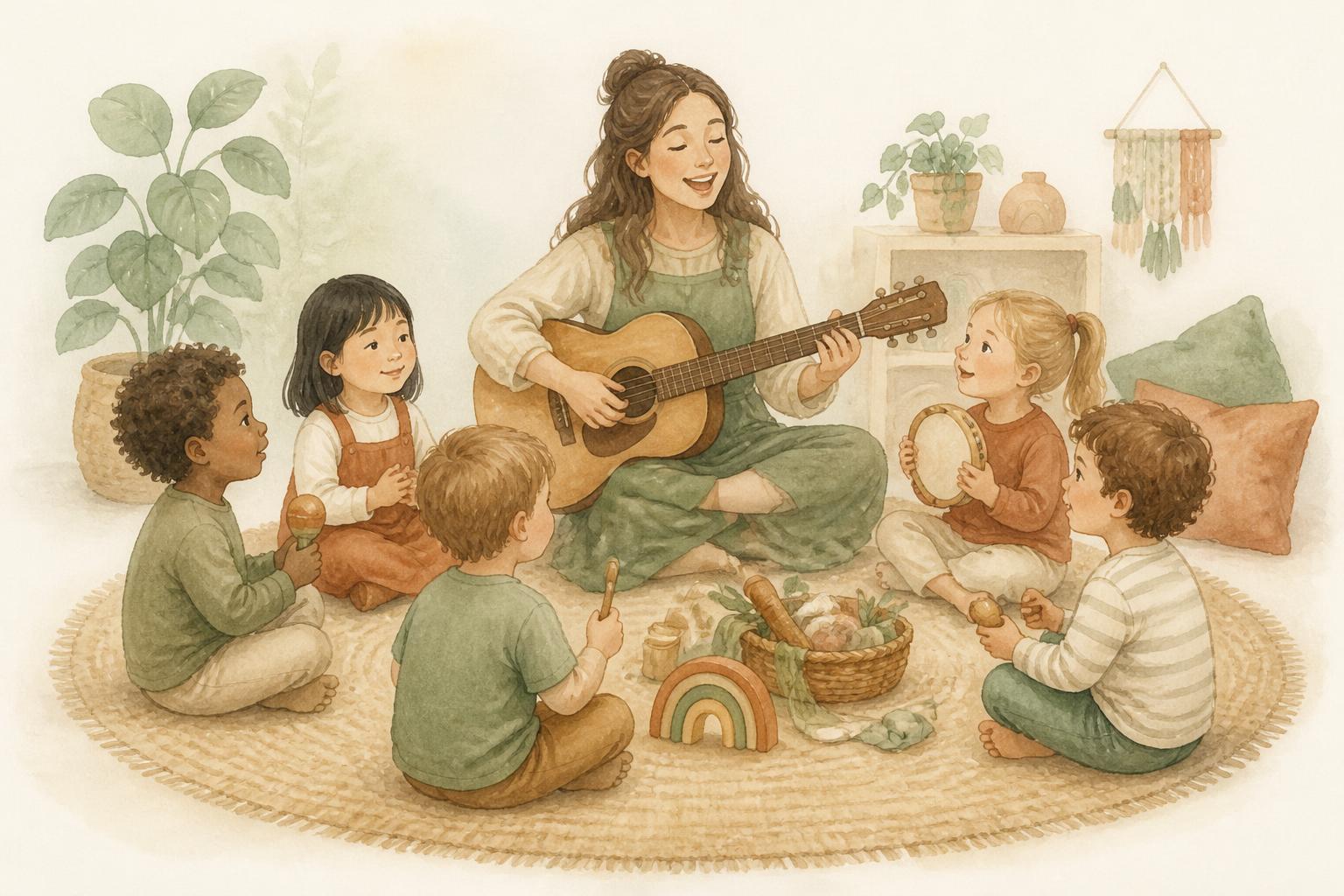
Why circle time goes wrong
It's too long. For most preschool groups, five to ten minutes is honest. Fifteen is a stretch. Anything beyond that and you are managing bodies, not teaching.
It's too passive. Sitting still and listening is the hardest possible ask for a three-year-old. Movement, singing and props are not extras; they are what makes the sitting possible.
It's badly timed. Circle time straight after a long wait, or just before lunch when everyone is hungry, is set up to fail.
It's compulsory. A child who genuinely cannot join yet is not being defiant. A nearby quiet option — where they can still hear and drift in — usually converts them within a few weeks.
Ten circle time ideas
1. Name song with a wave or a clap for each child, so everyone is greeted individually.
2. A feelings check-in using simple picture cards or a hand signal — thumb up, sideways, down.
3. A 'sound of the day' listening game: eyes closed, name what you hear.
4. Body percussion: pat, clap, stamp, repeat a pattern back.
5. Story with props from a bag, pulled out one at a time by a different child.
6. Movement break inside the circle — animal moves, stretch to the ceiling, curl up small.
7. Show and wonder: one child shares an object; the group asks questions rather than commenting.
8. Rhythm instruments with a stop-and-start conductor game — pure impulse-control practice.
9. Group breathing with a prop: blowing a feather, smelling flowers and blowing candles.
10. The day ahead in three pictures, so children can predict what is coming.
Infographic
The five-minute circle time that actually works
Short, active and predictable beats long, passive and improvised.
Greet by name
A name song with a wave or clap so every child is seen individually.
Check in
Thumb up, sideways or down — or simple feelings picture cards.
Move or make sound
Body percussion, animal moves or instruments with a stop-start game.
One short story or wonder
Props from a bag, pulled out by a different child each day.
Preview the day
Three pictures showing what happens next. Predictability lowers friction.
Close the same way
The same song or chime every time signals the transition out.
Joining is invited, not compulsory. A nearby quiet option usually brings reluctant children in within weeks.
Transitions: the real behaviour lever
Most difficult moments in a room happen between activities, not during them. Cut the number of transitions and you cut the friction.
Signal early and consistently: the same song, chime or phrase every time, two minutes before the change. The predictability is the point.
Never leave children waiting with nothing. A queue is where behaviour goes to die — use a song, a rhyme, or send small groups.
Give the transition a job: 'Carry one thing to the shelf on the way.' Purpose beats instruction.
Let children finish. A protected place to leave an unfinished construction removes an enormous amount of daily conflict.
How this links to Aistear and Síolta
Síolta has a dedicated standard on transitions, and Aistear's Well-being and Identity and Belonging themes both depend on children feeling secure in the rhythm of the day.
Reviewing your daily routine with the team — how many transitions, how long the waits are, who is left with nothing to do — is often a bigger quality gain than adding new resources.
Where our workshops fit
Our educator sessions on regulation techniques and behaviour as communication include a routine audit you can run with your team in twenty minutes, plus a booklet of transition scripts.
Each hour-long session includes a booklet and a certificate of attendance. Certificates record professional development; they are not CPD points, as that requires separate registration.
Frequently asked questions
- How long should circle time be in preschool?
- Five to ten minutes is realistic for most preschool groups. Beyond about fifteen minutes you are usually managing bodies rather than teaching.
- What are good circle time ideas for early years?
- Name songs, a quick feelings check-in, body percussion, listening games, story props pulled from a bag, instruments with a stop-start conductor game, group breathing and a three-picture preview of the day.
- Should children be made to sit at circle time?
- No. Offer a nearby quiet option where a child can still hear and drift in. Most reluctant children join voluntarily within a few weeks when it is genuinely optional.
- How do you manage transitions in early years settings?
- Reduce the number of transitions, signal each one the same way two minutes ahead, never leave children waiting with nothing to do, give the move a job, and let children protect unfinished work.
- How do transitions link to Síolta and Aistear?
- Síolta includes a dedicated standard on transitions, and Aistear's Well-being and Identity and Belonging themes rely on children feeling secure in a predictable daily rhythm.
Keep reading
- BlogThe ECCE scheme explained: free preschool in Ireland, in plain EnglishWhat the ECCE scheme is, what age your child needs to be, how many days it covers and how to apply — plus how to tell whether a preschool is a good fit.Explore
- BlogHow to handle toddler tantrums calmly (without giving in)When tantrums start, why they happen, what to do in the middle of one, and what actually reduces them over time — for 2, 3, 4 and 5 year olds.Explore
- BlogForest school in Ireland: what it is and how to bring it homeWhat forest school means, what happens in a session, what it costs in Ireland, and how to get the same benefits in a local park or back garden.Explore
- BookBook a workshopSee upcoming dates and book onlineExplore
- ContactAsk a questionSend Amy a message about your setting or familyExplore
Bring these ideas into practice
Book a workshop to explore this further with Amy.
Trusted early years resources
Every workshop is grounded in Irish early years frameworks and national guidance.
- Aistear: the Early Childhood Curriculum Framework (NCCA)
- Síolta: the National Quality Framework
- Children First national guidance (Tusla)
- First 5: Ireland's strategy for babies & young children
- Early Childhood Ireland
Workshop themes · Book a date · Counties we serve · Play & learning blog · FAQ · About Amy